
Affiliate disclosure: This article may contain affiliate links. If you buy through them, we may earn a commission at no extra cost to you. As an Amazon Associate I earn from qualifying purchases.
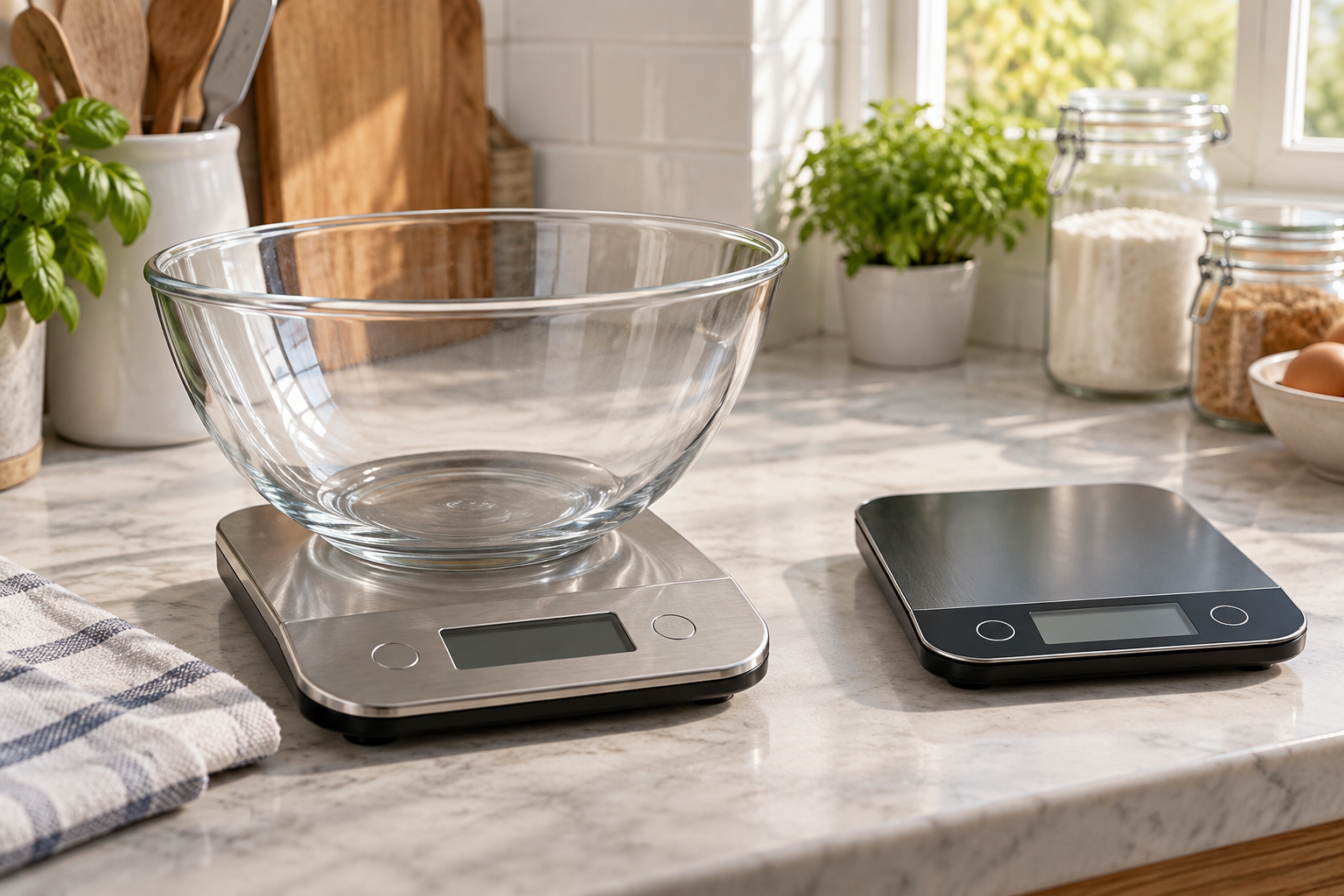
An 11-pound scale is enough when the whole load fits
For many household baking jobs, an 11-pound kitchen scale is a practical size. The deciding number is the weight of everything on its platform: bowl, ingredients and any other container. Tare makes the display easier to use, but it does not make a heavy bowl disappear from the scale’s physical load.
The Etekcity EK6015 and OXO stainless steel pull-out-display scale both have an 11-pound maximum. Their useful difference is display visibility, rather than extra load capacity. Before choosing, identify whether your problem is load, readability or very small ingredient quantities.
Subtract the bowl before planning the batch
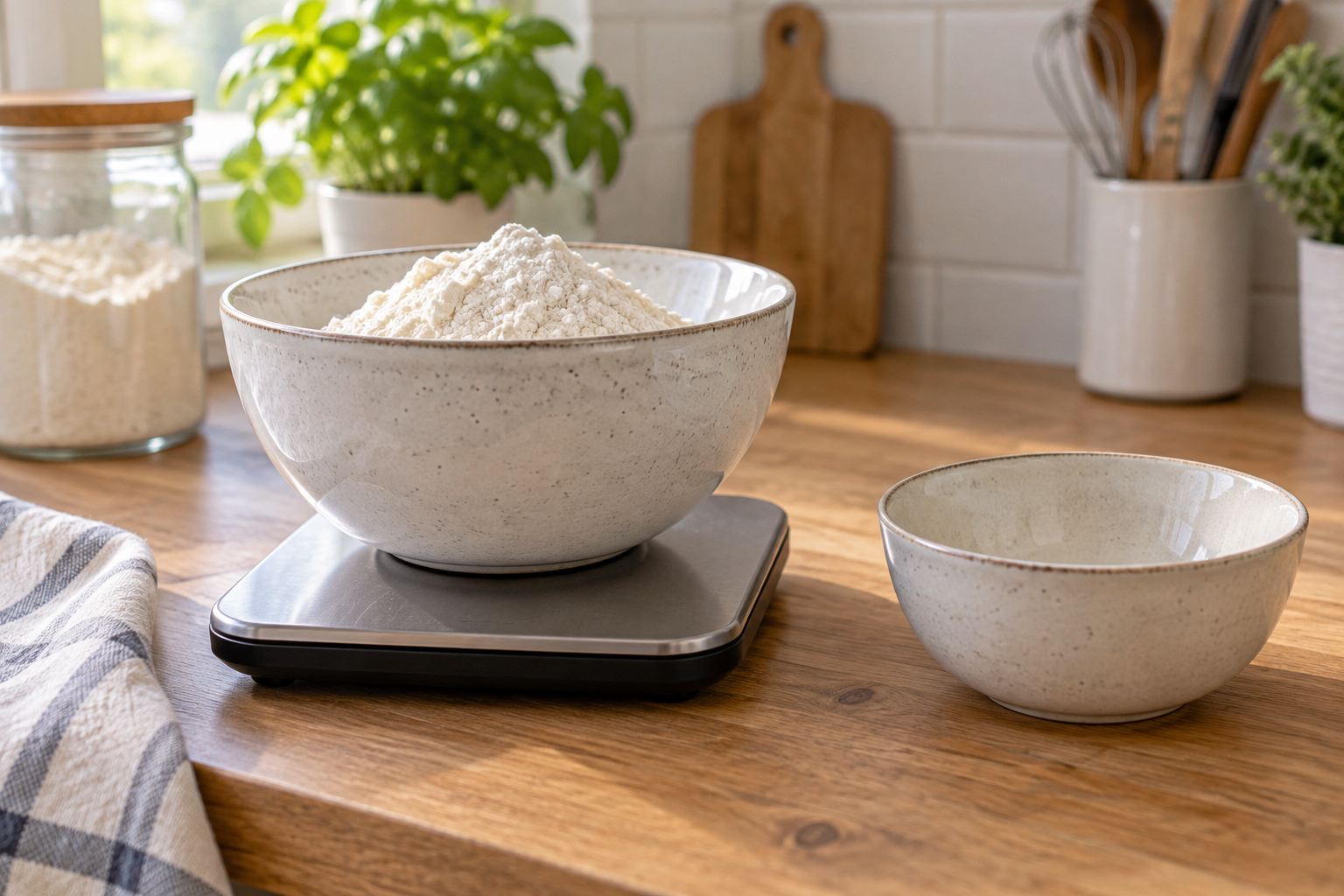
Using the EK6015’s published 5 kg limit, a hypothetical 1.2 kg bowl leaves 3.8 kg for its contents. A 4 kg mixture would bring that combination to 5.2 kg and exceed the limit even if the display was first tared to zero. These figures are an example, not measured bowl or recipe weights.
Weigh your own empty bowl, then total the ingredients for the batch you actually make. Include water and other liquids when adding them directly to the bowl. If the recipe approaches the limit, weigh ingredients in smaller containers or select a genuinely higher-capacity scale; replacing one 11-pound model with another will not solve the overload.
| Example load on a 5 kg scale | Weight |
|---|---|
| Empty bowl | 1.2 kg |
| Available capacity for ingredients | 3.8 kg |
| Hypothetical mixture | 4.0 kg |
| Bowl plus that mixture | 5.2 kg: above the limit |
Etekcity EK6015: straightforward weighing
The selected Stainless Steel EK6015 lists 5 kg / 11 lb capacity, 1 g display increments and two included AAA batteries. It is a sensible candidate for weighing flour, sugar and other everyday ingredients when the bowl fits and the display remains visible.
Set it on a firm level surface and keep the bowl centered without touching nearby objects. Select the unit used by the recipe before starting. When you add ingredients sequentially with tare, keep track of the total physical load rather than relying only on the latest number displayed.
OXO: a display you can pull into view
The OXO Good Grips stainless steel food scale also has an 11-pound limit. OXO identifies 1 g / 0.1 oz increments, a zero function and a pull-out display that can extend from under a large bowl. Its removable platform is another documented convenience for cleaning.
The selected stainless steel pull-out-display scale has the manufacturer’s 11-pound capacity. A large mixing bowl can hide a fixed display; extending OXO’s display addresses that viewing problem without increasing the allowable bowl-plus-ingredients load.
A one-gram step is not a precision guarantee
An increment tells you how the display changes; it is not a verified error range for every load. Both selected scales are ordinary ingredient scales. If your task requires reliable fractions of a gram, such as a very small dose of an ingredient, a display that moves in whole grams is a poor fit for that requirement.
Use recipe quantities and units consistently. A weight in grams does not need a generic cups conversion, and a liquid volume mode cannot turn every liquid into the same density. For small quantities, choose an appropriate verified finer-resolution tool or use the recipe’s stated method instead of claiming accuracy that the scale’s increment does not establish.
Check the bowl and the counter together
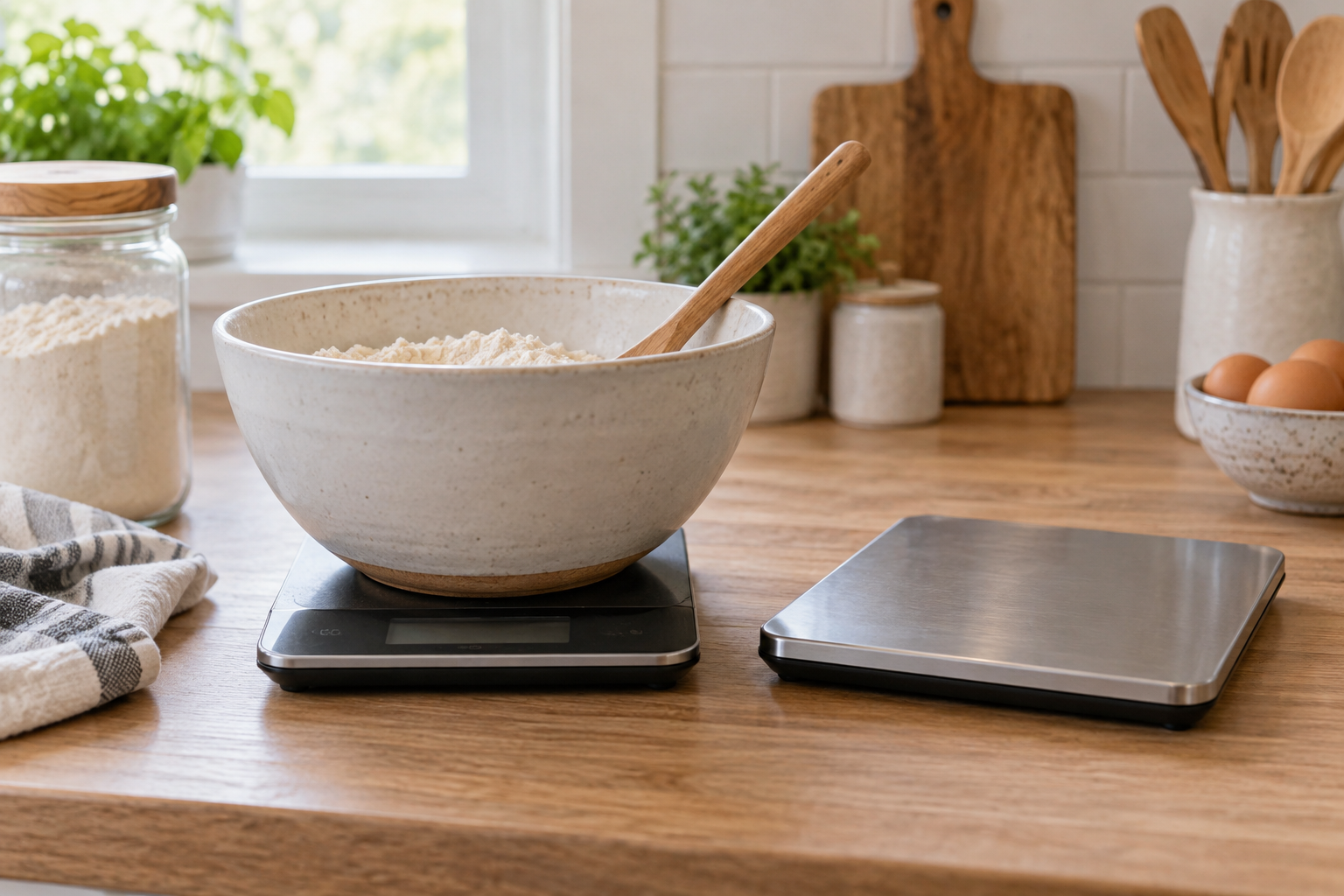
Place your usual mixing bowl on the platform and think about the viewing angle you use while adding flour. A broad bowl can obscure a fixed display even when its weight is well within capacity. A pull-out display is worthwhile if that is the recurring inconvenience.
Also allow space to move the OXO display outward. A crowded counter can erase the advantage if the display meets a backsplash, another appliance or a container. Keep scale electronics dry, clean according to the exact model instructions, and avoid leaving a heavy bowl stored on the platform.
Choose capacity first, visibility second
Pick the EK6015 when your everyday bowl-and-batch combination fits and its display is easy to read. Pick the OXO when the same capacity is sufficient but a wide bowl routinely hides the reading. Choose a higher-capacity model only after your own load calculation shows that 11 pounds is inadequate.
Before buying, weigh the empty bowl, add the recipe’s total ingredient weights, confirm the required increment, and decide whether you can see the display while pouring. Compare the current total purchase cost only after those requirements are met.
Related reading
Preparing a lined pan is another useful step before you weigh a baking batch. The linked parchment guide explains how to fit a liner for blind-baking.