
Affiliate disclosure: This article may contain affiliate links. If you buy through them, we may earn a commission at no extra cost to you. As an Amazon Associate I earn from qualifying purchases.
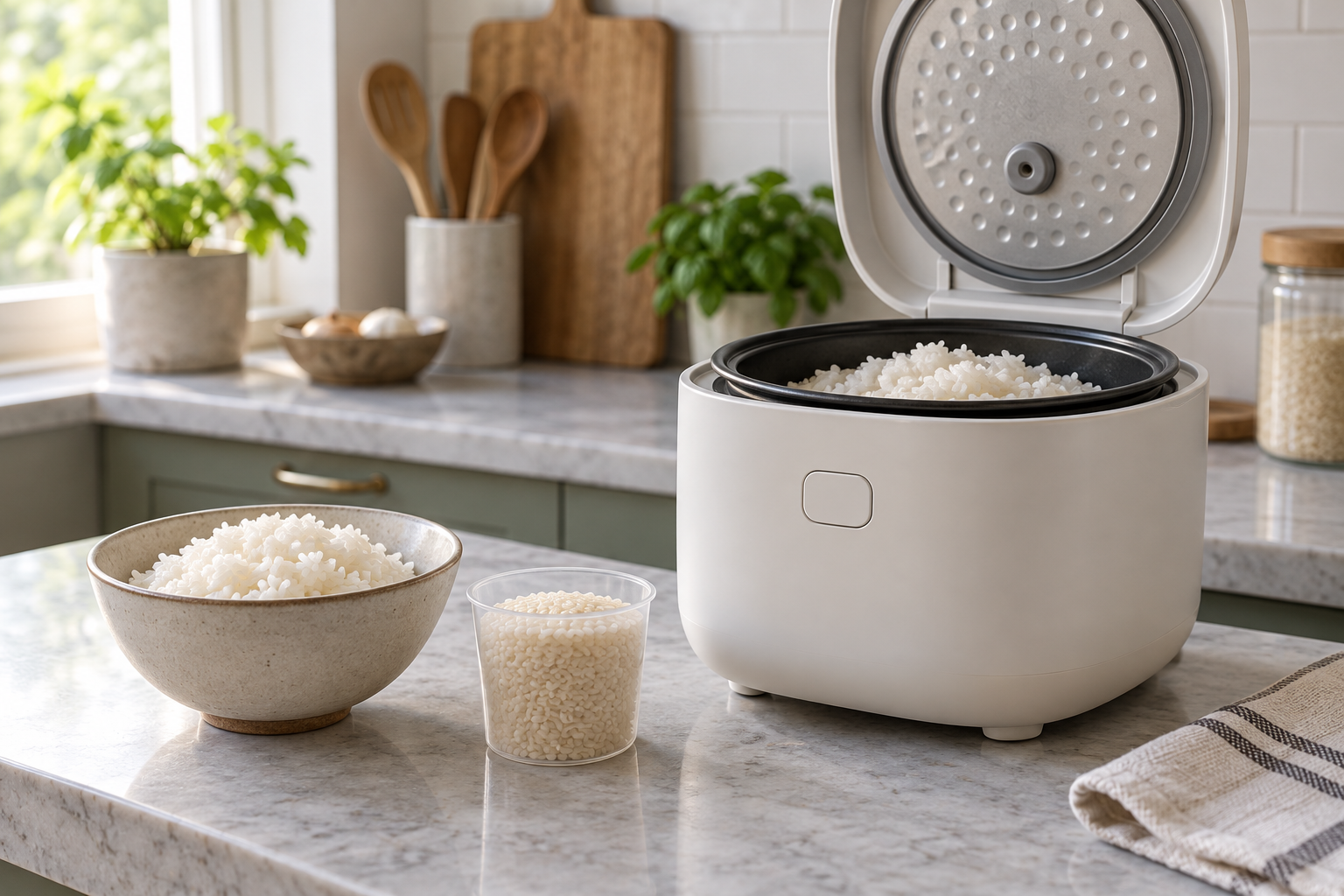
The advertised cups usually measure uncooked rice
For these Zojirushi cookers, the capacity is measured with the supplied approximately 180 mL rice cup using raw short-grain white rice. It is not a count of full US kitchen cups, cooked bowls or people. The NS-TSC10 is rated up to 5.5 of those supplied cups; the NS-LGC05 up to three.
Choose the cooker by the uncooked batch you normally prepare and the menu for your rice type. A household size alone is a weak shortcut. Two people cooking for several lunches can need more capacity than four people eating rice as a small side at one meal.
Keep the supplied measure and the pot markings together
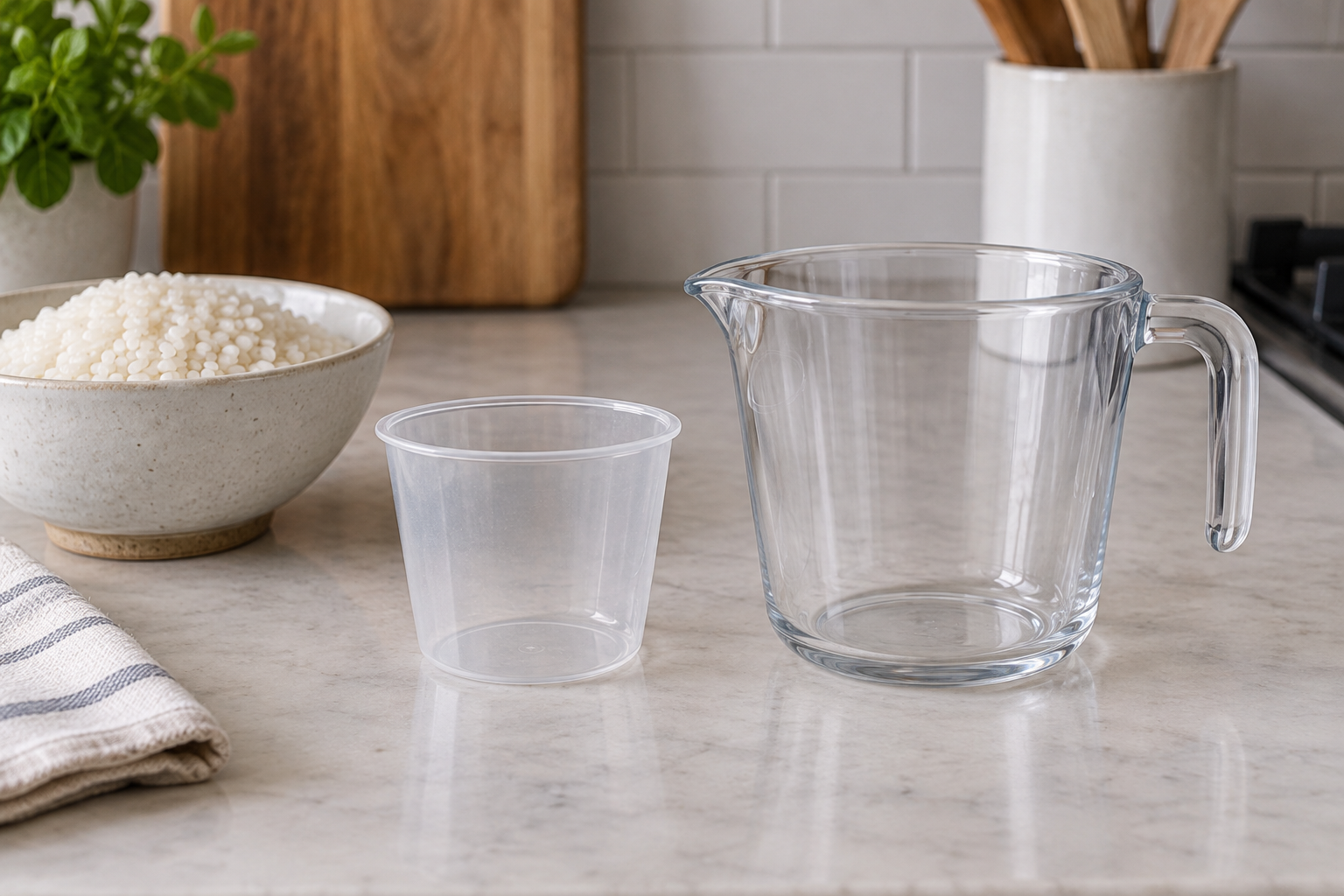
A standard US liquid cup is about 237 mL. Substituting it for a 180 mL rice cup adds roughly 32% more volume at the same count. If you measure a larger cup of dry rice but fill water only to the pot's one-cup line, you have changed the relationship the maker intended.
Use the supplied cup to measure dry rice, then follow the correct water-line and preparation instructions for that menu. A water line is not an empty-pot measurement to fill with dry rice. It belongs to a specified amount of rice already in the pot and the appropriate cooking method.
Swipe horizontally or focus the table and use the arrow keys to view all comparison columns. ↔
| Measure | Approximate volume | What it means |
|---|---|---|
| Supplied rice cup | 180 mL | Basis for these cooker capacity ratings |
| US kitchen cup | 237 mL | Different volume; not a direct substitute |
| NS-LGC05 rating | 3 × 180 = 540 mL dry-rice measure | Up to 3 supplied cups of raw short-grain white rice |
| NS-TSC10 rating | 5.5 × 180 = 990 mL dry-rice measure | Up to 5.5 supplied cups of raw short-grain white rice |
Do not turn an uncooked rating into a guaranteed cooked yield
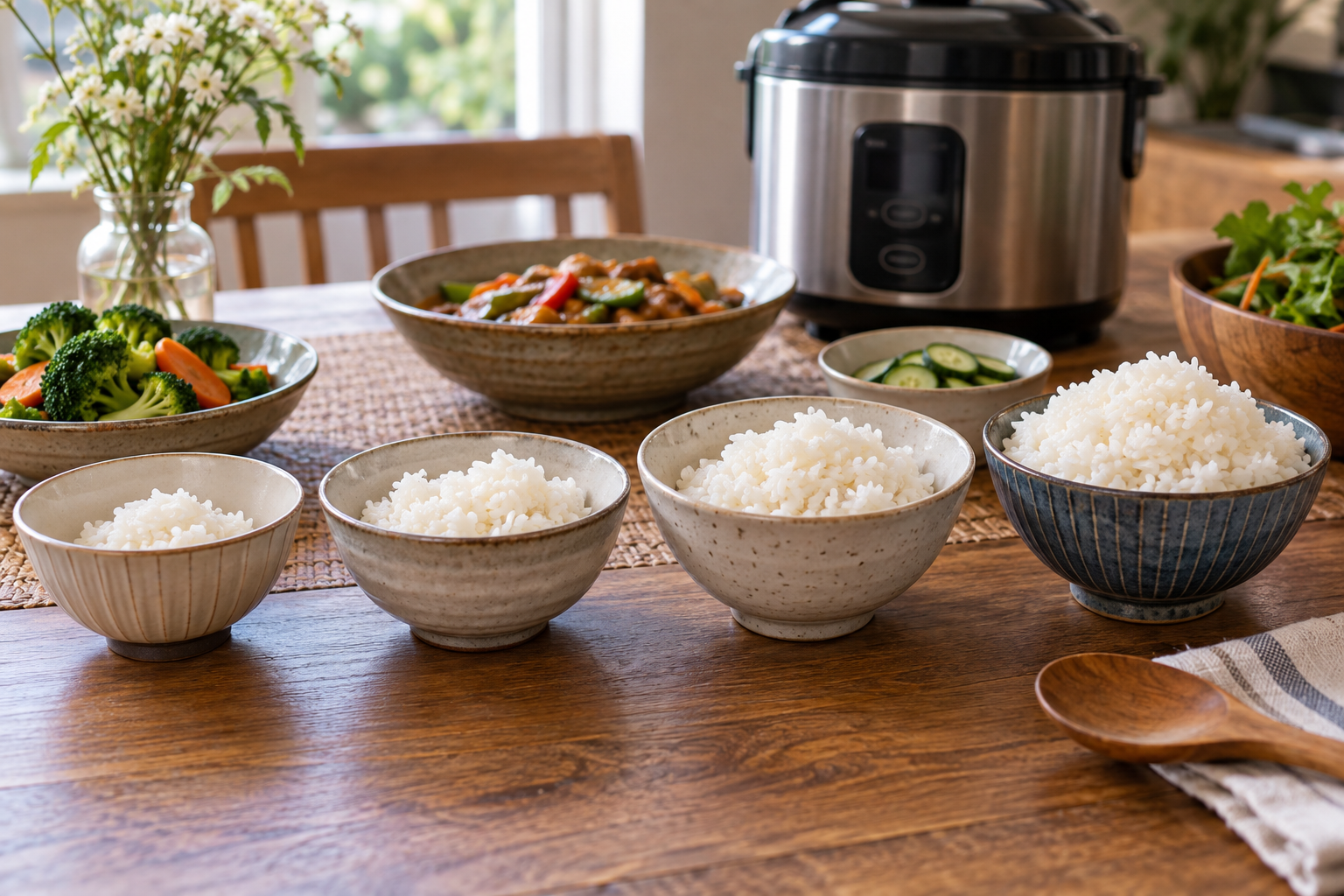
Rice expands during cooking, but the yield varies with rice, water, preparation and how loosely you portion it. A five-and-a-half-cup cooker is not a promise of five-and-a-half dinner bowls, and this guide does not assign a universal cooked-cup multiplier.
For a useful household check, record how many supplied cups of dry rice you use for a meal that leaves the amount of leftovers you want. Keep the serving bowl or portion measure consistent. That observation is more helpful than comparing your household with a manufacturer's general family description.
Use explicit batch assumptions
If two adults normally use one supplied cup of dry rice for a meal, both models have room for that stated batch. For smaller white or brown-rice meals, the compact NS-LGC05 supports half a supplied cup; its sushi program starts at one cup. Choose by the particular menu, rather than maximum capacity alone.
Preparing three such meals together gives a three-cup dry-rice batch. That reaches the compact white-rice maximum, but exceeds its two-cup mixed and brown-rice limits. The larger NS-TSC10 supports up to four cups for mixed and brown rice. These are explicit batch assumptions, not serving or cooked-yield guarantees.
Swipe horizontally or focus the table and use the arrow keys to view all comparison columns. ↔
| Assumed dry-rice batch | Compact NS-LGC05 | Larger NS-TSC10 |
|---|---|---|
| Half cup, white or brown | Within stated minimum | Below one-cup minimum |
| One cup, sushi | Within stated range | Within stated range |
| Three cups, white | At maximum | Within stated range |
| Three cups, brown or mixed | Exceeds two-cup maximum | Within four-cup maximum |
| Four cups, brown or mixed | Exceeds maximum | At maximum |
Match the batch to the exact menu range
The exact manufacturer manuals measure these limits with the supplied approximately 180 mL cup, using uncooked rice or dry steel-cut oats. The NS-TSC10 is the 1.0 L model in the shared NS-TSC10/18 manual; do not use the 1.8 L model’s column.
Use the menu-specific pan water marking and preparation instructions. Shared markings do not establish identical capacities across menus, and the manuals do not supply one universal rice-to-water ratio. “No dedicated setting listed” means the reviewed menu table does not list that setting; it does not mean that food can never be prepared in the cooker.
Swipe horizontally or focus the table and use the arrow keys to view all comparison columns. ↔
| Menu / dry ingredient | NS-TSC10 supplied cups | NS-LGC05 supplied cups |
|---|---|---|
| White rice; quick cooking | 1–5.5 | 0.5–3 |
| Sushi rice | 1–5.5 | 1–3 |
| Mixed rice; brown rice | 1–4 | 0.5–2 |
| Sweet rice | 1–4 | No dedicated setting listed |
| Rice porridge | 0.5–1.5 | No dedicated setting listed |
| GABA brown rice | No dedicated setting listed | 0.5–2 |
| Long-grain white rice | No dedicated setting listed | 0.5–3 |
| Steel-cut oats | No dedicated setting listed | 0.5–1.5 |
NS-TSC10: more room for planned batches
The NS-TSC10's 5.5-supplied-cup rating is useful when your normal raw-white-rice batch exceeds three cups or you intentionally prepare leftovers. The manufacturer's exterior size is 10-1/8 inches wide, 14 inches deep and 8-1/2 inches high. Check lid-opening and steam clearance as well as the closed size.
Consider the larger model when a regular dry-rice batch exceeds the compact menu’s limit: more than three cups for white rice, or more than two for brown or mixed rice. Its larger rating is capacity evidence, not a claim that it cooks better.
NS-LGC05: a smaller capacity with its own menu choices
The NS-LGC05XB is the genuinely smaller alternative, rated up to three supplied cups of raw short-grain white rice. Its official dimensions are 9-1/8 × 11-7/8 × 7-1/2 inches. Its menu list includes long-grain white rice and steel-cut oatmeal as well as white/mixed, sushi and brown-rice settings.
Its white and brown settings support half-cup batches; sushi starts at one supplied cup. Confirm your regular menu and batch before choosing it. A compact footprint does not extend the two-cup brown/mixed maximum or guarantee a cooked yield.
Choose from your dry-rice habit, then check the model
Write down your typical and largest planned dry-rice batches using the supplied measure, then use the exact menu ranges above. For small white or brown batches, the compact model starts at half a cup; both sushi ranges start at one. Extra headline capacity alone does not solve a smaller-batch need.
- Use the approximately 180 mL supplied cup consistently.
- Separate raw-rice capacity from cooked serving assumptions.
- Check menu-specific limits for the rice you eat.
- Include planned leftovers in the batch size.
- Allow for the lid, steam path and storage space.
- Check the selected model, offer and arrival date.